Comments
-
The future of peal ringingthe failure rate at most levels (in retention, as well as a reasonably useful upward sense of prowess) is high. Without stimulus from the existing band, there is little forward push for a new ringer to hone and advance their abilities. — DRD-mus
Although this discussion is about peal ringing, the "elite" level is dependent on having a healthy pyramid below it to draw from. I've seen all the issues you describe and while it's difficult to jumpstart a stuck band, it is possible, although it's a multi-year project. We are doing it by setting expectations for new ringers from the start that method ringing is the goal, and CCs / PH are just stepping stones. There are 3 of us who can ring methods and we are collaborating to support the other ringers. It's not always easy but there's great satisfaction in seeing people enthused and making real progress week-on-week - we are at the stage where the more recent starters are overtaking those who've been ringing for decades and are stuck at the same level. If existing ringers want to step up to the mark, great, but we aren't going to stop moving forwards.
I think the biggest challenge is to create the right culture, where continued progression is the norm. If people allowed to "top out" at CCs or PH-by-the-numbers it's difficult to rekindle the enthusiasm that made them take up ringing in the first place. -
The future of peal ringingI think it would be quite hard to find out how many quarters first pealers had rung
AFAIK BellBoard data is in a MySQL database so it would be trivial.
A district ringing master should be aware of people who could be encouraged to ring peals
That's a misassumption. And in any case, there have only been 15 peals registered in my association + county this year, all in the same small area and all 1+ hour away. So peal ringing in my association is already dead.
That illustrates my concerns about many of the conversations in this forum and the direction the CC takes in general. They are driven by people who are generally in areas where ringing is still in reasonable health, even if not exactly thriving. They struggle to square their personal experience with the situation in other areas - "It can't really be that bad". Well, I'm afraid, yes, it is. -
The future of peal ringingpeal ringing is only of academic interest to me (my last QP inside was PB6 2+ years ago) but I think peal ringing is important and needs supporting. My QPs were prefaced by lots of longer touches at practices, I assume QPs serve the same sort of purpose for peals? It might be possible to mine BellBoard to find the average ringing history of first time pealers, e.g. how many QPs had they rung in the year before their first peal. You might then be able to use that to identify potential first-time pealers.
-
The future of peal ringingwell done him, but not all young ringers are going to have the confidence to do that. From the discussion so far, there are enough barriers as it is.
-
The future of peal ringingI can't see that I'll ever ring a peal but from observation of people who do, it does seem like it's a bit of a closed shop - "X's peal band" and so on. If you are going to invest the time in a peal the reasons you give for selecting people are understandable, but on the other hand it can make it hard for people to "break in". I'm not sure what the solution is, "peal clubs" perhaps, with a larger pool of ringers to draw on? Dunno.
-
The future of peal ringingWhat is the future of peal ringing? I suspect it is much like the rest of ringing – increasingly nucleated around clusters of ringers — Jack Page
I think you are right - I don't thing it is going to die out because there are still enough talented younger ringers like yourself to ensure it doesn't, but the volume of peals will likely fall. As to whether that's going to be a permanent situation, who knows? As I understand it ringing has had many troughs and peaks it's difficult to predict the future. Personally my biggest ringing regret is that I didn't find out and start when I was much younger, if I had there'd have been a chance I'd be at least a jobbing peal ringer ;-)
I little while ago I proposed 3000 as a target, which meets the point Jack makes about establishing quality ringing but would be more accessible — Simon Linford
I think @Phillip George may have given the reason why it didn't take off. To ring even 3000 you need to be "peal fit", and that's probably best done by ringing frequent QPs first. I know QP numbers have rebounded reasonably well since COVID but I wonder what proportion of those were in preparation for longer lengths rather than being a goal on their own?
established peals bands don't routinely give young ringers the opportunity to join them — Simon Linford
Does age really have anything to do with that? -
The future of peal ringingQPs are much closer to the pre-COVID numbers. Perhaps 3+ hour stints of ringing have just gone out of fashion?
-
Funding target and direct membership
the simplest option is same people that do so already on a per-association basis. Any decent management system would support that.who would be authorised to update the information? — Alan C -
Funding target and direct membershipthere's no reason why things such as tower contacts couldn't use centralised infrastructure and distributed management. That seems to work quite well for BellBoard, for example. I'd much prefer to have a centralised system for finding tower contacts where I didn't have to care about association boundaries or waste my time figuring out yet another different website layout.
-
Funding target and direct membershipOur current deal puts us out of kilter with similar hobbies in terms of the expectation of paying for our venues in addition to equipment. — Tristan Lockheart
Our hobby has sufficient differences from others that you can't draw direct comparisons. For example how many brass bands play 250+ year old instruments weighing a tonne or so and which are part of a building?
The emphasis on providing labour is perhaps misplaced when what we actually need to get the work done is cash, — Tristan Lockheart
Cash for what? For most plausible CC projects, person-hours are always going to be the biggest chunk of resources.
it is important to acknowledge that RW provides several important services — Tristan Lockheart
I think it's important to distinguish between the weekly lump of dead tree that you are asked to pay £100 a year for and the other services that RW provides, such as books/booklets and BellBoard. The other services have real of value, but I can't see The Comic surviving in its current form. Even the online version is poor, a PDF of something that's formatted for a physical medium is dreadful for mobile devices, for example.
This means that their support for Dove etc. is not a given — Tristan Lockheart
I disagree, I think it pretty much is.
Some say that it oversteps the Council's authority to be getting involved in local affairs, duplicating territorial association provision. — Tristan Lockheart
There's been posts on here recently about the parlous state of many associations, even the mighty Yorkshire is struggling. Duplicating the same services across multiple associations is a poor use of scarce resources and there's no justification for continuing that situation, other than the inertia of the associations themselves. -
Funding target and direct membershipRinging has a massive cultural problem with free-riding — Tristan Lockheart
I strongly disagree with that. It's a depressingly common sentiment and a counterproductive one. If ringers can't convey the value they bring to the CofE, then nobody else is going to either.
We ring on bells in buildings we don't really pay for
- The majority of bell installations were paid for by public subscription many decades ago, the capital costs to the CofE for bells are effectively zero.
- The presence of change ringing bells in church buildings has limited effect on running costs of the building, the steeple / tower would usually be there anyway and would still require maintenance.
- The majority of funding related to bell installations is raised by ringers, without them that money wouldn't be available to benefit the CofE.
- Ringers have an entire funding mechanism for maintenance of assets they don't own, in the form of BRFs.
- Ringers don't get paid to ring for services, unlike organists.
- When ringers do get paid, for weddings, there's usually a "tower tithe" taken for ongoing maintenance. As far as I know, that's not something organists do.
- It's normal practice for visiting ringers to pay steepleage.
- Ringers contribute 10s of thousands of hours of free labour every year for bell maintenance.
- Ringers contribute 10s of thousands of hours of free skilled tuition to learners.
None of that is unusual within the CofE, churchwardens, flower arrangers, most choirs etc do the same in their areas and ringers play their part as well. Categorisation of ringers as "freeloaders" by the ringing community itself is harmful and doesn't reflect the view of the CofE or its parishioners. For example this year two of our ringers have been awarded Bishop's Badge awards:
The Bishop's Badge award recognises outstanding contributions of lay people to congregations, local communities, and the Diocese.
And from last year's awards:
On receiving his Bishop's Badge in September, John Sterland said: "My late father whilst being a member and former tower captain of St Andrew’s (Swanwick) received a badge a few years ago for his work supporting the major refurbishment of the clock and bells at St Martin’s Alfreton. I feel quite reflective and privileged at being recognised in a similar way."
There is an expectation that the Ringing World should exist for news and recording achievements, but subscriptions continue to decline in the face of rising costs.
- The RW often reads like an Old Boy's newsletter and as such seems to be primarily of interest to those at the end of their ringing careers.
- £100 / year for something that's dominated by lists of ringing performances which are already online is ridiculous.
- There isn't enough good material to publish it weekly, a monthly publication at 1/4 the cost might be more attractive.
- RW is a commercial enterprise, categorising its lack of appeal to many ringers as "freeloading" is wrong. Its problems are RW's problems, not those of its potential audience.
Information sources like Dove or UniversityRinging are funded/maintained by the Central Council yet aren't paid for by their users.
- Dove's users are generally members of associations, as has been discussed ad nauseam they pay money to the CC so yes, they are paying for it.
- I'd be interested to hear just what the hosting costs are for hosting of the Dove website and a low-end MySQL database. I suspect not much, the primary "cost" is the large amounts of unpaid time put in by those who develop and maintain it (see above).
Mid to high-level ringers are invested in by towers, often to then go on to greater things or move to other parts of the country. Many "pay it back" but many don't or can't.
- There's a degree of truth in that, but I don't think it's a new issue.
- There's a strong culture of "Pay it forward" in ringing and it's the exceptions to that which are most noticeable.
it [CC] is not and must not be involved locally such that individual ringers feel a strong direct benefit.
- Eh? Why shouldn't the CC be involved locally and provide direct benefit to ringers?
-
Is ART the answer to recruitment, training & retention? Expand ART carefully from NOW to deliver?please don't disrespect those who practice it. — Robert Brown
No disrespect intended, the quality of the ringing that Devon bands demonstrate is second to none and yes, much better to have well struck call changes than poor method ringing. I think the existence of the CCCBR Devon Call Changes website, written by an ex-CCCBR president to promote the art to the wider ringing community shows that Devon CC ringing is valued. My own tower, well away from Devon, rings 60 on 3rds regularly and one day we might even get to a level of striking that wouldn't get us laughed at in Devon - although I suspect we'll never cut the mustard when it comes to raising and lowering.
The issue, as @John Harrison says, is the way CCs are used outside of the Devon tradition when the striking is poor and people try to ring methods the same way, by bell number and not place and so on. So the criticism is about Method ringing, not Devon ringing, -
favouristism and experienced ringersThe fault is not teaching the right skills in the first place. — John Harrison
That's what I was getting at. I know people who try to stop learners using bell numbers, which I think is futile. What I do is explain the limitations, so they don't fixate on numbers and have a goal to ring by place. So far that seems to be working. -
favouristism and experienced ringersYou are unusually fortunate to be in a tower where cambridge major is regularly rung, — Rosalind Martin
This is very true. I have to travel 45 mins each way every 2 weeks for 2 half courses of Cambridge Major.
At a tower where I used to teach, there was a core of long-established plain hunt ringers and no matter how I tried I could not find a way to lead them forward and away from ringing by numbers.. It was a bit like children learning to swim and being reluctant to let go of the edge of the bath! — Peter Sotheran
That seems to be common and as such, I don't think can be entirely the fault of the ringers, I think the way ringing is taught is a large part of the problem - letting people learn a difficult skill one way (by bell numbers) and then expecting them to be comfortable ditching that for places is always going to be fraught. And I think the same applies to the Circle of Work. -
A Job Description ...it seems that the St Clements centre is experiencing a huge demand from new ringers in Cambridgeshire who cannot get the tuition and support that they need from their local band. — Roger Booth
I think that's common, and not just for new learners. I went to an all-levels 8-bell practice that was called within the archdeaconry with just a week's notice. 24 people turned up. The ringing covered Rounds to Cambridge so there's demand across the board. -
favouristism and experienced ringersThis looks awfully like teaching people how to teach, and it's only a small subset of the material on the ART website that's there to support people teaching ringing.
-
favouristism and experienced ringerssure I understand that. But there's really no justification with ART being so well established.
-
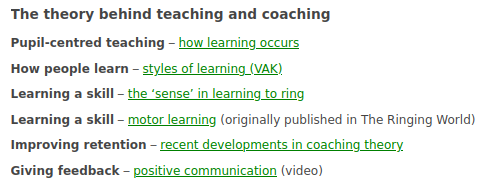
favouristism and experienced ringersThis seems to have disappeared from the CCCBR website but I think it's an excellent guide to ringing teaching:
Retention of Ringers - Recent Developments in Coaching
Tip 8 seems particularly relevant to this discussion:
Do not show favouritism to any learner -
favouristism and experienced ringersthere's a fairly widespread assumption that a prerequisite for being a good ringing teacher is being a top-flight ringer yourself. Of course there are lots of instances where that's true, but lots of others where it isn't - and why would it be the case in ringing when it's not true in other teaching? I think it's also important to remember that learning to ring isn't learning a single skill - someone who is excellent at teaching method ringing may be much less skilled when it comes to teaching handling.
One of the important skills of a teacher is to have multiple approaches and to find the one that "clicks" with a particular learner. In my opinion, anyone who can only teach people who think in a similar way to them is not a good teacher. -
favouristism and experienced ringersit's more common than it should be, unfortunately - in some towers particularly if you aren't in the first flush of youth. I don't have any really good solution to suggest - in my experience someone who has allowed the issue to occur in the first place is unlikely to modify their behaviour if you say something. You either have to suck it up or go elsewhere, which is what I've done in the case of one tower - and two other ringers have since followed suit. Unfortunately some towers / ringers aren't interested in bringing people on unless they fit a very narrow profile. Such towers are the walking dead but don't realise it - best to go elsewhere and leave them to their fate.
John de Overa

Start FollowingSend a Message
- Contact Us
- RingingForums Policy
- Terms of Service
- Useful Hints and Tips
- Sign In
- © 2026 Ringing Forums