-
 John de Overa
644In the first 7 months of 2025 ART awarded 335 L1, 182 L2, 77 L3, 48 L4 and 24 L5 certificates. The biggest gap was between L2 and L3, where method ringing starts.
- L1 → L2 drop - 45.7%
- L2 → L3 drop - 57.7%
- L3 → L4 drop - 37.7%
- L4 → L5 drop - 50.0%
That's broadly in line with the situation in 2018, where the L2 → L3 was also the largest one.
Sources:
Those are counts of certificates, so they don’t tell us what happened to the same people. Does ART track how many ringers who pass L2 go on to pass L3 within two years? If so, could it publish the figures?
I’ve never got past L4 on paper, but I’ve carried on ringing. Getting regular opportunities has been an issue for me. Has ART asked learners who stopped progressing through LtR whether they wanted to ring methods and, if they did, whether they could get enough regular practice?
Thanks! -
 Lucy Chandhial
177I think ART do have some stats on where learners drop out of level completion but I think only anecdotal feedback on why.
Some, like you, continue progressing without getting the levels signed off. Others slow down and take a long time to be able to sign off the next level.
The level 5 masterclass is one motivation to keep getting signed off all the way through and we did talk about the possibility of a level three ‘reward’ event to encourage people to get signed off at level three and not just reach the standard without sign off.
As part of Tower Talk I’m trying to get stories / experiences from some of the people who do get signed off a level, especially at those later levels.
I have it on my long list of not even written down tasks to find out whether we could automatically email people who reach a level with a request for their story.
I imagine it is also possible to have an automatic email to people who have not updated progress for one year to ask what’s holding them back and this could give some interesting insight.
@Neil Jones - one for discussion on the next ART Management Committee perhaps! -
John de Overa
644Some, like you, continue progressing without getting the levels signed off. — Lucy Chandhial
I haven't had L5 signed off because of a combination of COVID's impact on ringing, illness on the part of my tutor and because I haven't had the opportunities to ring the necessary QP. I'm hoping to get those sorted in the next couple of months, ring a QP of Norwich Surprise Minor and get L5 signed off - I've rung 2 QPs of it this week on the tower sim in preparation.
I'm clearly not alone in finding it a challenge to get to L5 and there are all sorts of reasons why that might happen, for example once you get to L3/4 your role often changes and you can become one of the ringers who supports ringers in your tower rather than being supported by them. That's obviously a good thing, but it does mean your own progress can stall.
Another "hole" that springs to mind is that not everyone who is taught "The ART Way" is interested in participating formally in the scheme. For example I have taught 4 adult learners who are now mainstays of our band but who weren't interested in registering.
The CCCBR survey this week set me thinking, it made little mention of ART and I wondered if ART had any stats on why people disappear from the scheme at such a high rate - only 5% - 7.5% of people get through to L5. I was wondering if ART could do its own survey to find out, and perhaps consider what it could do to help? -
 Neil McGann
5My own experience is that I don't really have an ART teacher at any of my regular towers, so won't be appearing in the statistics.
I'm technically L1, which reflected my initial tuition by an ART teacher, but am well in to the more complex doubles and elementary minor ringing at my home tower(s). Lack of QP opportunities means I could never progress through the levels anyway. -
John de Overa
644@Simon Linford wrote a RW article about ringing's "hole in the middle", the ever widening gap between "basic" ringers and more advanced method ringing - "The Death of the Red Zone", 24 Oct 2025. Sounds like you are stuck at that point, I would be as well if I didn't have access to a tower sim. That's not without its downsides, things I can ring on the tower sim entirely by ear such as Bristol are a different matter altogether when ringing with a real band...
-
Lucy Chandhial
177[things I can ring on the tower sim entirely by ear such as Bristol are a different matter altogether when ringing with a real band...]
I’m interested in trying to create some kind of top tips guideline for ringers who do a lot of solo simulator learning and then need to be ready to adapt to the imperfect rhythm of ringing with a ‘real’ band.
I hear frustrations from both the simulator learner and some of the ringers they then ring with and I think some kind of guideline of what to expect the differences to be, perhaps what to try to say to help someone correct if they are used to a perfect simulator rhythm and are less likely to use ropesight, that sort of idea. If @John de Overa you would consider trying to write (or video record) something like this please email me as I think it would be a useful resource. RDLeadatcccbrdotorgdotuk -
John de Overa
644If you would consider trying to write (or video record) something like this please email me — Lucy Chandhial
Sure, I'll give it some thought and send you an email. Unfortunately there's no "quick fix", it's always going to require adjustment when ringing with real ringers. For example you can set Abel to strike less regularly in several different ways but I've never found it all that convincing - the mistakes real ringers make tend to come in "clumps" rather than all the time.
I think like any training aid, the main thing is to understand that is exactly what it is. I've just come back from a session where I rang a QP on the sim, followed by two of our other ringers using it for an hour. In my case the goal was to keep up concentration and not wander off into the weeds, making silly method mistakes. The other two folks were ringing quicker than our band normally does, the goal was to sharpen up bell control, learn to pull only just as much as needed, move up & down the tail end etc. What's important is to have a clear goal. For example you want to practice treble bobs at the back until you have it nailed? Sure,you can ring the same half lead over and over until you are sick of it. A human band would be off down the pub after 10 mins :grin: We have several musicians in our band, including teachers, they all say that repetition of small chunks is a standard teaching tool, yet ringing it's all or nothing, and if you crash out - bad luck, try again next week.
I've heard a lot of negativity about simulators, my usual response is "OK, so tell me where the regular weekly practices are for people wanting to get into Surprise ringing are, and I'll go there instead" - at which point it goes very quiet. I think use of sims is going to become more common, not less. -
 Roger Booth
142I think use of sims is going to become more common, not less. — John de Overa
I think you need to come at the use of simulators from a teaching point of view, rather than the traditional ringing one.
Yesterday, at the Winchester School of Bell Ringing, Matthew Higby installed a training bell at St John’s Winchester, and Ian McCallion has given us an evaluation copy of ‘HawkEar Go’, a new app for use on a smartphone. We have been using this with the Alresford band for the last few weeks and have learnt a lot.
The accuracy of each ringer’s ringing can be expressed in terms of standard deviation from the normal, measured in milliseconds. We now have a record of the accuracy of each ringers ringing measured over several touches. This means that we can now focus 1:1 simulator time on those who are the least accurate ringers.
Traditionally, Guilds and Associations hold one day or half day listening skills ‘courses’. But these are not courses. They are seminars where people listen to recordings of bells and practice spotting the errors. They are often surprised at how well they can do, but putting this into effect on the end of a rope takes many hours of practice. There is usually limited rope time on the day itself.
Some time ago Doug Nichols sent me some statistics of teaching done at Orange, New South Wales using Virtual Belfry. Over the course of a year, with regular practice, those who struck with standard deviation of around ± 120 msec. reduced this to around ± 80 msec, and those with an accuracy of ± 60 msec got it down to about ± 40 msec.
All to often simulators are used a form of sound control, or as a status symbol for the tower, and are not used to ‘teach’. Traditionally people are taught to plain hunt by knowing the numbers and watching the ropes. They are not taught to listen, that often comes later, sometimes at a listening skills course (seminar), but it is more difficult to acquire this skill if you have not been taught to do it from the outset. Pupils need to be taught both listen and watch. They won’t be able to see the right rope if their bell, or the one that they are following is not in the right place.
You can’t teach both with a simulator alone, but if you use the simulator as a tool and teach both together, the ringing will be so much better and the pupils progress will be quicker and smoother. It is so much easier to learn to ring methods if the ringing is steady and the other ringers are in the right place,
Bell control is also so important. A basic standard is required to ring rounds, call changes involves a little more, and method ringing involves increasing more, especially as the changes of direction become more frequent. At the Winchester School of Bell Ringing we plan to use the training bell not just to teach listening skills, but also to then go on and help pupils master the three speeds ringing. We will do this using the kaleidoscope leaning exercises in Abel.
We plan to do this at St John’s, and the other towers in the Winchester District that we use which are equipped with simulators. We are training our teachers in how to do this. It means that we will be able to teach of pupils the basic skills needed to ring methods, without resorting to the traditional techniques and needing a large group of steady helpers, who are in increasingly short supply.
It was interesting to read the report of the CCCBR’s 1958 survey and the proposals for more ringing courses. However, apart from the jamboree effect, I am not convinced that traditional courses produce a lasting effect . With them the ‘rope time’ for each pupil is limited, and often people do not get the opportunity for the rope time needed when they return to their home towers. This may be one of the reasons why progression in the Learning the Ropes scheme is held back.
It would be interesting to hear the views of Nicki Thomas of the Mancroft Ringing Discovery Centre and Lynne Hughes of St Clement’s Cambridge on their regular weekly teaching sessions, their use of simulators, and the progress made by the pupils who attend. -
John de Overa
644The accuracy of each ringer’s ringing can be expressed in terms of standard deviation from the normal, measured in milliseconds. — Roger Booth
This sounds similar to existing Abel features, you can either have a early/late green/yellow/orange/red bar over your bell on the moving ringers display, or you can look at striking blow by blow. It's often a depressing exercise :lol:
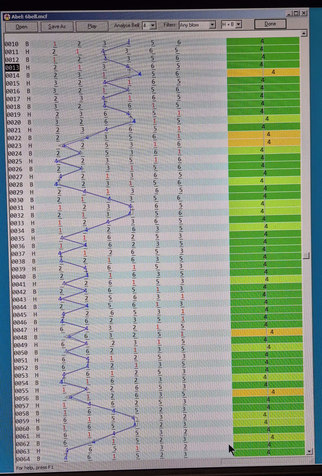
You can’t teach both with a simulator alone, but if you use the simulator as a tool and teach both together, the ringing will be so much better and the pupils progress will be quicker and smoother. It is so much easier to learn to ring methods if the ringing is steady and the other ringers are in the right place, — Roger Booth
That has certainly been my experience, both personally, and when helping others. It means that people are better prepared to make use of the often limited rope time they have with a real band.
Bell control is also so important. A basic standard is required to ring rounds, call changes involves a little more, and method ringing involves increasing more, especially as the changes of direction become more frequent. — Roger Booth
I'm helping two ringers who are starting to ring methods, and based on my own experience we've focussed quite heavily on improving bell control, which didn't initially go down too well but has paid dividends for them. Bell control that is good enough for you to bluff your way through Plain Bob, one bodged dodge at a time, completely falls apart when you start ringing "proper" methods where you need to do lots of "stay in the same place" work. It can be quite demotivating - you think you can control a bell well and then you find no, you can't. A simulator is helpful for getting over this hump in progress.
It means that we will be able to teach of pupils the basic skills needed to ring methods, without resorting to the traditional techniques and needing a large group of steady helpers, who are in increasingly short supply. — Roger Booth
Agreed, I had access to a tower sim through COVID and no other ringing opportunities. I went in just about being able to ring a QP of PB, I came out ringing Cambridge. COVID was the best thing that happened for my progress :lol:
I am not convinced that traditional courses produce a lasting effect . With them the ‘rope time’ for each pupil is limited, and often people do not get the opportunity for the rope time needed when they return to their home towers. This may be one of the reasons why progression in the Learning the Ropes scheme is held back. — Roger Booth
I've never been on one, partly because I've heard people who teach at them say they they see the same people each year, with little progress inbetween, for the reasons you give. Most of the people who I know who have been on them have gone precisely because they lack appropriate opportunities in their home towers, but they are keen to progress. Unfortunately, I think a few days a year on a course isn't going to help all that much. And in my case, yes, lack of opportunity is exactly what's held me back - if your home tower doesn't ring much beyond PH then it's challenging and often slow progress to get beyond that. -
Roger Booth
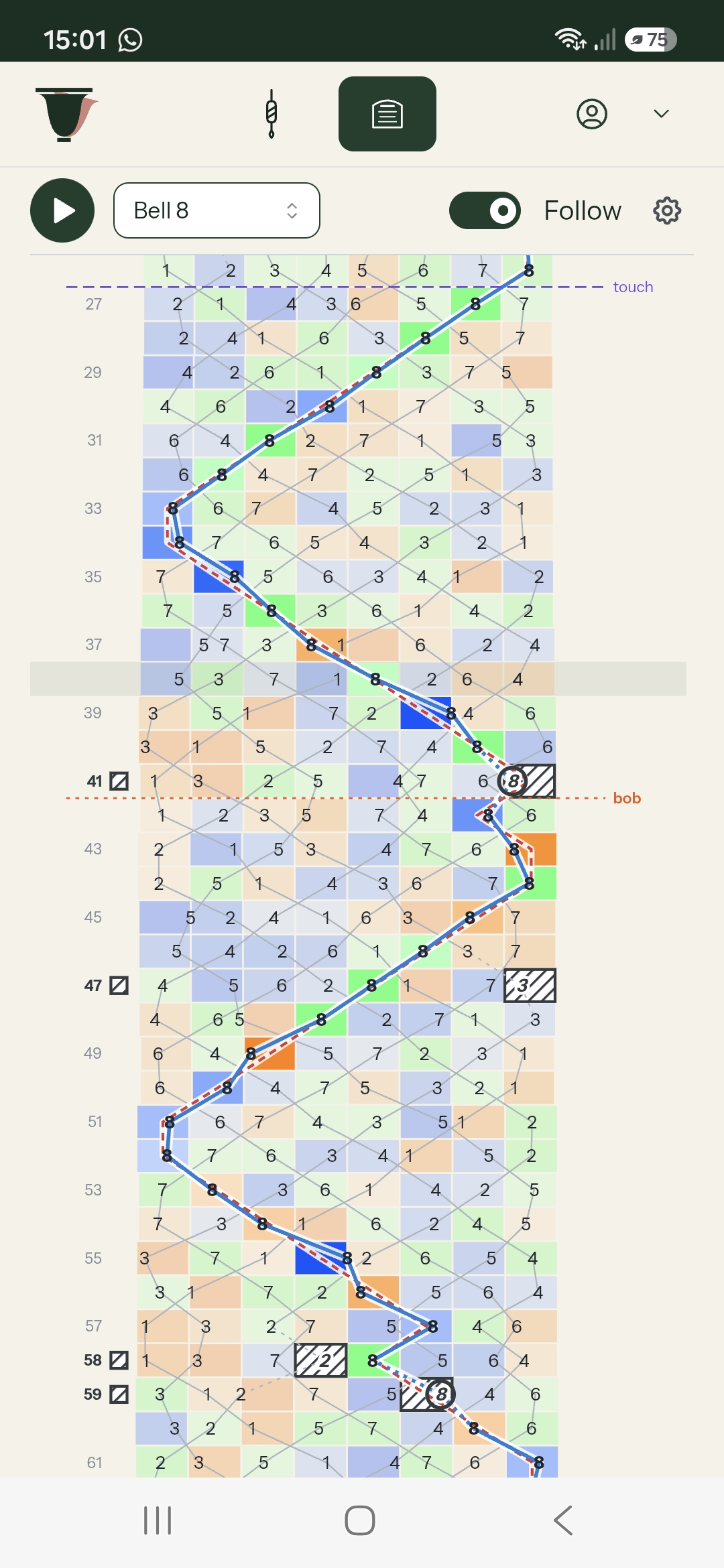
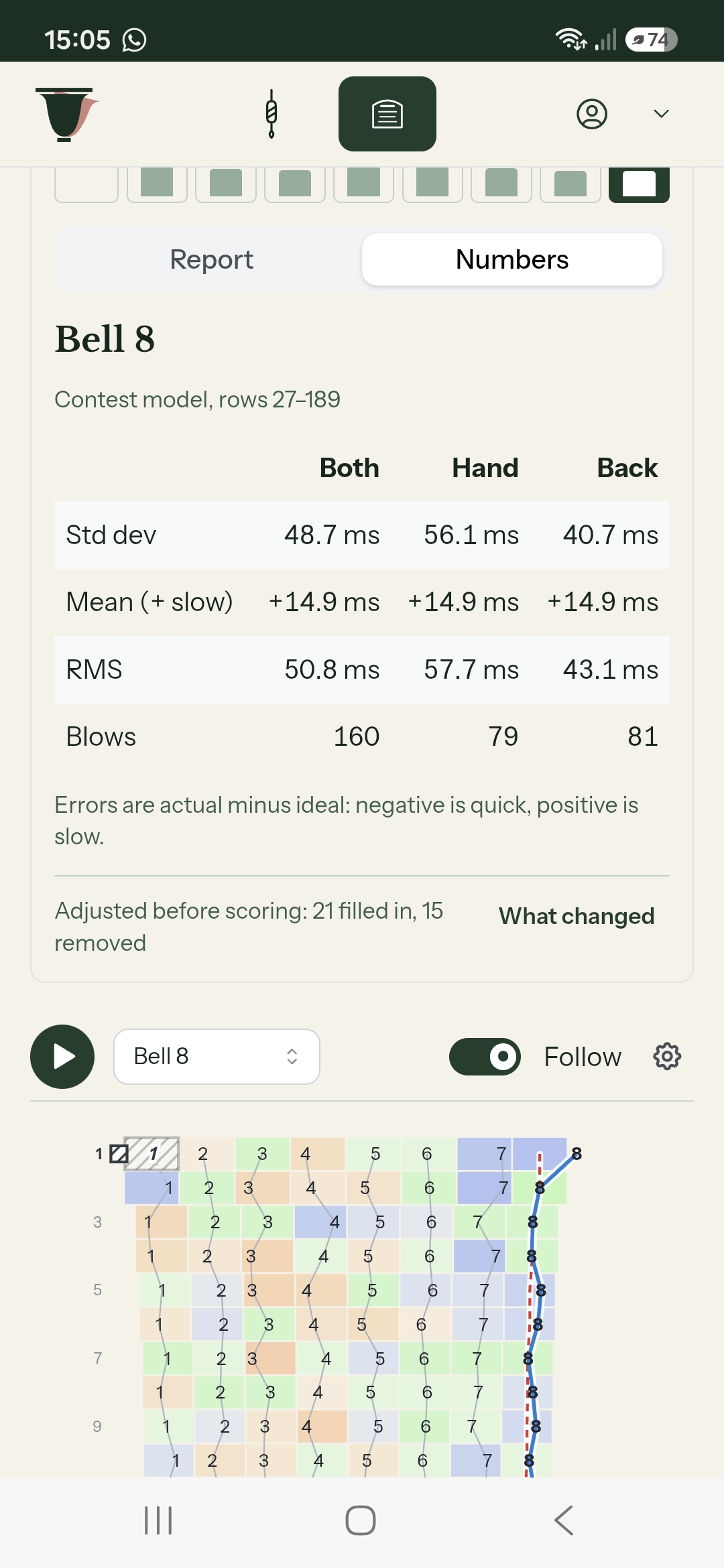
142John. Looks like we are on the same wavelength. Here are some screenshots from the beta version of HawkEar Go. It saves the need to set anything else up in any tower. You can use it straight away for any ringing. Blue is late, red is early, green is OK. The darker the colour, the more out it is, and there' a lot of analysis pages to view, and you can play back the recording:
-
John de Overa
644Here are some screenshots from the beta version of HawkEar Go. — Roger Booth
Just figuring out the diagrams - I assume the first one is with a live band and is showing all 8 bells (PB?) with the heavier line highlighting bell 8#s striking? And the second is drill down for bell 8?
The first screenshot looks similar to the main part Abel's display, you can select a bell and see its stats. There are 2 barcharts at the top of the screen, which look like they display sort of similar information to your second screenshot? You can also filter by Hand / Back, up / down dodges etc, which is quite useful.
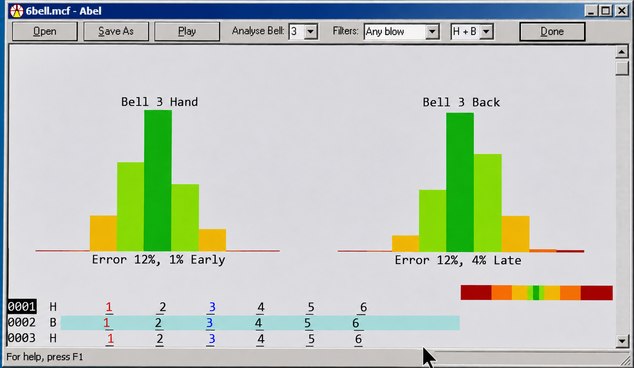
The problem with Abel's display is that the intervals for each of the colours isn't defined anywhere I can find, although the horizontal bar suggest the ranges aren't evenly spread. It also uses percentages rather than milliseconds - the chart is of a 1296 of Norwich Surprise Minor I've just rung, so the 12% equates to just under 40ms, I'm blaming the method mistakes I made :snicker: The handstroke 1% early figure means on average I was 3ms "off centre" and the backstroke 4% late is around 13ms "off centre", so I need to get those backstrokes in! :rofl:
I'm not sure which is better, ms or %. I think probably % as it's less dependent on peal speed?
You can use Abel in a similar way to HawkEar Go, by having it running during normal ringing but with the simulated sound turned off, then using it for a post mortem. That needs sensors on all the bells though, which we have. But usually people are horrified when I show them the analysis screen, and make me delete it :naughty: -
Roger Booth
142John. You're right about Abel. To get figures of standard deviation etc. you need to download and use CAS Striking Analysis Software to analyse the file.
Abel's help file also says: "In each bar chart, the central dark green bar shows how many blows were accurate (close to perfect!); to the left, other bars show how many blows were early, and to the right bars show blows that were late. Beneath the bar charts, there is a text summary of the striking for the bell. For example, it might say "Error 23%, 18% Late ". The Error percentage shows the average distance that the bell was from its correct position: if the figure is much larger than the Late/Early figure, it shows that the striking was rather unsteady. The "Late" or "Early" percentage shows if the bell has a general tendency to be early or late (being late at backstroke is very common!). Ideally all the reported figures should be zero - but in practice this is impossible to achieve. A good ringer should be able to achieve around 4% error when ringing from the keyboard, and should aspire to better than 10% error when ringing with external tower bells"
If you can get within the figures above, I would say that's pretty good! -
Neil McGann
5That's an interesting point. I've come at simulators from a different direction that experienced ringers appear to. I used a simulator just on my laptop (no physical dumbell/tied bell) to learn ropesight by watching the little moving ringers. That worked really well and has quickly transferred to the tower with some adjustment for the different rope circles. I also use the simulator on a (very light) tied bell whenever I can and overall it has massively accelerated my progress.
However, that doesn't work so well to develop accurate striking as it's primarily visual the way I have been using it. I'm working now to try and properly integrate listening and rhythm in to the mix. I find that very hard as there is the time delay between action and sound to contend with and I think that only practice with a real band will help with that. I'm fortunate as one of my regular bands is very good, but individual time is so limited on practice nights that progress is a lot slower. -
 John Harrison
597it. I'm working now to try and properly integrate listening and rhythm in to the mix — Neil McGann
If you have access to a simulator on tower bell, or a dumbbell heavy enough to have some ‘feel’, then ring with the visuals turned off, or face away from the screen. That will force you to rely on ringing steadily by rhythm to place the next blow and listening to correct your rhythm.
Then if you’ve already got ropesight cracked you shouldn’t find it too hard to overlay after you’ve developed the basics. -
John de Overa
644ring with the visuals turned off, or face away from the screen. That will force you to rely on ringing steadily by rhythm to place the next blow and listening to correct your rhythm. — John Harrison
I can confirm this works, to the point where I now have to remind myself to look at the screen when I'm learning something new & complicated - I find it easier to visualise the line without the distraction of the screen. I almost always ring just by ear when covering and sometimes I stop looking if I've wandered off into the weeds - often to the consternation of the other ringers :lol:
What I would say though is that for me there's a striking penalty if I don't look at the moving ringers, the visuals are 1-2 seconds before the sound which allows fine adjustment, whereas with no visuals you can only correct after the event.
The other thing I've noticed is that ringers who are much better than I am often bang on about ringing by rhythm but actually can't do it very well - I suspect the majority of ringers ring by vision. I certainly know of ringers who are technically far more advanced than I am who are almost completely lost either on the simulator or without being able to see other ringers. It's much harder than it sounds... -
 John Gwynne
2hi John I’m curious under what name do you ring quarter peals? I can’t find you on bellboard.
I’ve been ringing for donkeys years now, but my approach to progressing when I was at your stage, was to (my words) plague the life out of people. I’m sure they would agree. If you want to progress you’ve got to make the effort, drive the miles, try to make the right friends. -
 David Smith
21Going back to John's original question, I encourage learners to use the LtR progress booklet, and to officially get tested at LtR 1 and LtR 2. There's are marked drop-off of enthusiasm for getting the formal LtR pass at LtR 3 (to some extent) and definitely for 4 and 5. This is not because they stop ringing or lose enthusiasm for ringing, nor is it any fault with ART - it is often because once they start ringing regularly with the band, this provides their motivation and their goals, so they become less interested in LtR passes. I don't see this as a problem. Certainly in some cases the lack of LtR progression may result from a lack of opportunity to ring at the relevant level, but I don't think it would be wise to interpret LtR drop-off stats as indicating anything in particular.
-
 Cara
4For listening practice, hopefully the simulator on your laptop has the "click your button and it starts your ringer moving" setting (i.e. there is the proper time delay between you pressing the button and your own bell sounding)? In which case start ringing very simple things like that, with your eyes shut. The rhythm aspect is twice as hard without the natural swing of the rope of course, so in theory it's very good training for that also.
-
John de Overa
644I don't think it would be wise to interpret LtR drop-off stats as indicating anything in particular. — David Smith
We'll never really know either way unless people are asked. Considering the amount of effort that it takes to get someone ringing methods, I think it would be helpful to find out how far people have got and what sort of issues they've met. -
 Graham John
377I've just been developing ringing accuracy stats for Handbell Stadium (example below). It seems to me there are two different skills you want to measure. Most simulators only measure the second, and I haven't seen one that separates them.
The first is method ringing accuracy: how well you know the method. A blow is counted as correct if it falls anywhere between the ideal positions of the bells either side of it in the row. Because Handbell Stadium tracks a pair of bells rather than one, it also flags the common error of ringing your pair swapped over. When you're using a simulator to learn a new method, method ringing accuracy is primarily what you want to know.
The second is striking accuracy: how close each blow is to its exact place in perfect rhythm. This matters more once you know the method and are polishing your ringing.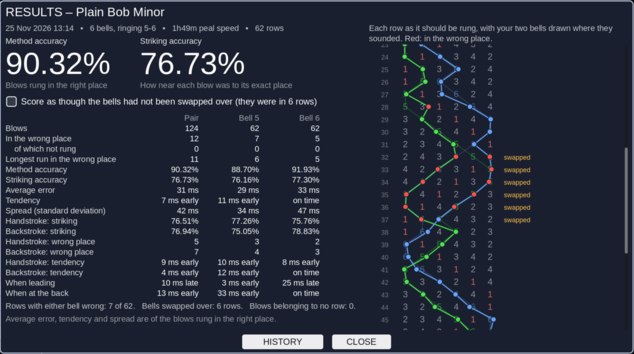
-
 Elaine Scott
8Back to the original point of this discussion I think the assessment and general targets from level 2 to 3 are too large. It takes much longer to get to a standard to ring a quarter than to manage to get to levels 1 & 2. It would be good to have more interim targets and theory before going on to ring quarters.
-
John Harrison
597an interesting topic i would like to comment on but could you start a new thread since it is way off topic on this one.
-
John de Overa
644Back to the original point of this discussion I think the assessment and general targets from level 2 to 3 are too large. It takes much longer to get to a standard to ring a quarter than to manage to get to levels 1 & 2. It would be good to have more interim targets and theory before going on to ring quarters. — Elaine Scott
Completely agree, but L3 only requires trebling and tenoring to QPs of Doubles, the most advanced thing for L4 is ringing a QP of PB5 inside, for L5 it is ringing a QP of PB6 inside. Those can be done formulaically, "Circle of Work", "Pass the treble" etc. Like many people I suspect, I crashed my way through to L4, then started to look beyond it. Oh boy, method theory, treble bob, more than one dodge at a time, better bell control, 8 bells... I more or less had to start over, it was eye opening.
One of the main challenges was "Learning how to learn methods", up until this point it was endless PB, perhaps a little GS5 which is really just double hunt PB. I saw that more experienced ringers could apparently learn new methods quickly, how were they doing it? I relied mainly on The Whiting Society How to Learn Methods booklet, there's also the CCCBR Learning Methods which I found subsequently and is also very good. Oh, and let's not forget "The Learning Curve" articles. What these give you is game changing, not "Try to remember this wiggly line" but how methods actually work. Yes it can be mind bending to get your head around at first, but even absorbing just a few bits of them is revelatory. It also means you can finally understand what the gee-whizz ringers are trying to tell you, which makes them much happier as well! You can start to teach people basic forms of these techniques very early on, as soon as people begin Plain Hunt (or even before). But I've rarely seen that done, perhaps I've just been to the wrong towers?
I've taken a look at the ART Learner's site, the "Ringing Toolbox for ringers" section is barely adequate even for PB, section 6.2 "How to learn the theory" has a load of stuff about cognitive psychology and absolutely nothing about actually learning methods. The "Ringer's Guide to Learning The ropes" link is broken. My biggest criticism of the ART syllabus beyond L3 is it's about meeting targets and not learning the techniques you need to take you beyond L5.


Welcome to your Ringing Forums!
If you would like to join in the conversation, please register for an account.
You will only be able to post and/or comment once you have confirmed your email address and been approved by an Admin.
Categories
- 2026 Ringing Census
- BELL INSTALLATION & RESTORATION PROJECTS
- CALL CHANGES
- CCCBR Consultation
- EDUCATION AND TRAINING
- GENERAL
- MEMBERSHIP SOFTWARE
- MEMBERMOJO
- METHOD RINGING
- METHODS
- COMPOSITION
- CONDUCTING
- HANDBELL RINGING
- PUBLIC RELATIONS
- RECRUITMENT & RETENTION
- Ringing 2030
- RINGING SIMULATORS AND SOFTWARE
- RUNNING A TOWER
- TOWER MAINTENANCE
- YOUNG RINGERS
- DEVELOPMENT PATHWAYS
- SCHOOLS
- UNDER 18s RINGING
- UNIFORMED GROUPS
- UNIVERSITY RINGING
- YOUNG RINGERS HUB WEBSITE
- YOUTH LEADERS
More Discussions
- Contact Us
- RingingForums Policy
- Terms of Service
- Useful Hints and Tips
- Sign In
- © 2026 Ringing Forums