-
 Robert Brown
27I dont disagree that there are things that need to be done centrally , my biggest issue is how its done . I.e if you take the cost of sending multiple reps to a meeting which could be done on line and used that money differently you could fund a lot more grass roots activity.
Robert Brown
27I dont disagree that there are things that need to be done centrally , my biggest issue is how its done . I.e if you take the cost of sending multiple reps to a meeting which could be done on line and used that money differently you could fund a lot more grass roots activity.
In addition and I can only speak from example in Devon organised events are becoming less well supported and recruitment remains a challenge , a lot of time and effort was spent on Ring for the King with little long term impact from what I can see, and certinely locally that was the case.
Has the CCCBR looked at the retention of ringers from that initative and lessons learned. A similar question that could be thrown at ART
I think there are a number of crisis approaching at 67 im often the youngest in the bands I ring peals with, there are going to be mass closures of churches many with fine peals of bells , we are seeing this already locally and church attendance in many areas will become non existent in the next 10 years linked to inevitable closures.
As I said im not saying there shouldnt be a central body just that from experience the CCCBR failed to reform into something a lot more leaner and be able to show positive and quantifed outcomes.
The other problem is that given that most ringers have little interest in the CCCBR there is little in the way of challenge or feedback on performance. -
 Lucy Chandhial
165@Robert Brown - “if you take the cost of sending multiple reps to a meeting which could be done on line and used that money differently you could fund a lot more grass roots activity.”
Lucy Chandhial
165@Robert Brown - “if you take the cost of sending multiple reps to a meeting which could be done on line and used that money differently you could fund a lot more grass roots activity.”
I think that generally in ringing money is not the issue and what prevents more activity being offered (at any level, grass roots or centrally) is people’s willingness to invest time.
I like that people can now choose to be part of a workgroup and therefore aim to make some impact without needing to also be an elected rep for their Association or Guild but I do also see that this leaves some reps ‘only’ turning up once a year to represent and not actively contributing or questioning what’s being done.
We see that in many areas the enthusiasm of new ringers is being funnelled into activity which helps to grow ringing opportunities for everyone and this is definitely a good model which can support re-vitalisation of ringing but it does depend (usually) on good support and encouragement from more experienced ringers.
I think the big challenge with the demographic change in ringers across the years is the availability of free time and the willingness to invest time in organising ringing opportunities, including supporting less experienced ringers.
There are other threads in ringing forums which have discussed how to create more opportunities, what we learnt from Ring for the King as a big recruitment campaign with insufficient teachers available and much much more but I don’t think the cost of getting to the Central Council weekend is a significant factor in ringing opportunities for local ringers development around the branches and districts of associations and guilds which are affiliated. -
 John Harrison
585a lot of time and effort was spent on Ring for the King with little long term impact from what I can see, — Robert Brown
John Harrison
585a lot of time and effort was spent on Ring for the King with little long term impact from what I can see, — Robert Brown
The research I reported in The Ringing World a while ago suggests thatbig recruitment drives do not have a lasting effect. If you didn't see it there's a copy at: https://jaharrison.me.uk/New/Articles/RecruitmentDrives.pdf -
John Harrison
585people can now choose to be part of a workgroup ... this leaves some reps ‘only’ turning up once a year to represent and not actively contributing or questioning what’s being done — Lucy Chandhial
There have always been Council members who 'only turn up once a year'. Even when Council committees were staffed entirely by Council members around 60% did not serve on a committee.
When members were only fed information once a year they could be forgiven for focusing their contribution on the meeting weekend, but now that the Executive has to report every month as well as annually, there are more opportunities to ask questions and if necessary take action. That oversight role is now more important with the Council run by a more powerful Executive.
That role doesn't need 200 people and I suspect being part of such a large group dilutes the feeling of individual responsibility. A smaller meeting would also cost less, and the dynamic of a 'meeting room' would be different from that of a 'lecture theatre'. -
 Jonathan Frye
18Areas I would like to see addressed by the CCCBR is, and given the governace structure , why do Guild etc send multiple reps, — Robert Brown
Jonathan Frye
18Areas I would like to see addressed by the CCCBR is, and given the governace structure , why do Guild etc send multiple reps, — Robert Brown
A jolly for a couple hundred members doesnt do that — Robert Brown
This is a recurring theme on here and elsewhere the Council members don't really do anything, they don't report back and the whole thing is just a jolly.
Given that CCCBR reps are appointed by the guilds and associations, I wonder why people choose to continue to send reps if they do not believe that they are doing a good job.
In my Association over the past decade we have given consideration to what we want to achieve from CCCBR representation and then sought out the people to do it. I believe that we have had significant positive influence on the Council, including helping to lead the CRAG work.
We are entitled to send two reps. If we send two then we incur the costs of sending two, of course. There have been periods when we sent two, and times when we only send one. We decide whether we think it is necessary to send two (we don't consider sending two purely for the purposes of registering two votes to generally be a good use of resources). Again, it is a conscious decision about what we want to achieve. At present we send two reps.
I dont disagree that there are things that need to be done centrally , my biggest issue is how its done . I.e if you take the cost of sending multiple reps to a meeting which could be done on line and used that money differently you could fund a lot more grass roots activity. — Robert Brown
I don't see it as an either/or, do both. -
Jonathan Frye
18@Graham John has provided an excellent list of a great number of things that the CCCBR does.
The fact that there are many ringers who don't know that it is the CCCBR that does them doesn't mean that they aren't valuable.
They can still deliver value to people even though they are unaware who is doing them, or even that they are being done at all. The things that happen quietly in the background are often not acknowledged because they work so well that people don't even know they are happening.
I suspect that most ringers are entirely unaware of the technical mechanism by which their Apps, Ringing Room or Bell Board magically have a list of every known method. But as Graham lists as his first item, that is a service that works like clockwork provided by the CCCBR. And ringers do value that, even if they don't know where it comes from or who provides it. -
Lucy Chandhial
165I agree that smaller groups tend to take more active responsibility in making decisions than big groups.
Roger talked about having workshops on a topic instead of business meetings (at Guild level) and this would also, probably, be more productive as a use of face to face time when people have travelled especially. -
John Harrison
585The CC has used workshop format meetings.
Under the old regimme, most years there was an Open Meeting the day before the Council meeting when a hot topic would be debated at length. As the name suggests they were open to anyone to take part. Sometimes they were stand alone (eg in 2000 I ran one on what we had learnt from the Millennium recruitment drive) and at other times they expllored a topic that was on the eganda for the meeting, for example in 2016 over Council reform. Generally they worked well and were useful.
The nearest there has been under the new regime is short sessions before the main meeting where workgroup activity can be discussed but in practice they were more 'presentation + questions than debate. There have also been sessions on the morning after, which were less rushed but still not really a debate.
The Council is responding (perhaps over reacting) to criticism that meetings were too long, and to the desire to offer something else. Inevitable adding a mini roadshow and/orlocal training events into the same total time squeezes the business, especially if you reatain the traditional tower grab. -
 Peter Sotheran
156I echo several of the points raised by Nick Cronin. Here in the Cleveland & North Yorkshire Branch of the YACR, distance is a significant limiting factor. The branch covers a geographical area similar to Kent, South London and the eastern half of Surrey. When I chaired the branch several decades ago (and petrol was 4s.10d per gallon - about 4p/litre) it was not uncommon to make a 100-140 mile round trip to chair a monthly ringing meeting. However, those meetings on the same Saturday afternoon each month, were predictable and followed a regular pattern. Despite the distances, attendances were consistently around 25-30+ and ringers at all levels were generally confident that any support they might need as they developed their ringing, would be available.
Peter Sotheran
156I echo several of the points raised by Nick Cronin. Here in the Cleveland & North Yorkshire Branch of the YACR, distance is a significant limiting factor. The branch covers a geographical area similar to Kent, South London and the eastern half of Surrey. When I chaired the branch several decades ago (and petrol was 4s.10d per gallon - about 4p/litre) it was not uncommon to make a 100-140 mile round trip to chair a monthly ringing meeting. However, those meetings on the same Saturday afternoon each month, were predictable and followed a regular pattern. Despite the distances, attendances were consistently around 25-30+ and ringers at all levels were generally confident that any support they might need as they developed their ringing, would be available.
Perhaps one ofthe answers to the question of involvement is to have regular meetings on a predictable schedule and to ensure that there is sufficient support for developing ringers. -
John Harrison
585we too used to get attendances of 30+ for monthly Branch practices 40 years ago, and they were predictable- 6-9pm on the 3rd Saturday. But predictable time or not we wouldn’t get that many now. Other things have changed since then. And distance isn’t an issue, all our towers are within 8 miles of me. However, most practices are just ringing with no meeting, so the boringness or otherwise isn’t an issue either. The lack of engagement of about half our members seems to be driven by something else.
-
Peter Sotheran
156I think that the YACR risks further disengagement from its members. As I understand the situation, members are now each required to renew their membership individually, online. Previously annual sub's were collected by the TC and forwarded to the Hon. Treas. or handed over at a branch meeting. This new remote system relies on members (a) remembering to go online and (b) making the effort to do so, a particular challenge if they don't happen to have the Association's URL on their shirt cuff. I've been a member for just shy of 60 years but I usually have to Google for the link to the YACR website!
Collecting/paying the subs in person brings with it the personal touch, the smile or words of thanks and the engagement with others. Paying remotely will benefit those more remote members who have little contact with the Association but will do nothing to bring members into closer engagement with the Association. Almost half of the members of my tower rarely if ever visit other towers and never attend the occasional meetings. They have joined the YACR because, in the tower, there is an expectation that they will. For newly recruited & trained ringers it is seen as a sign of recognition that they 'have made it' and can call themselves ringers. But if left to their own devices I cannot see most of them making the effort to renew their sub's remotely. I foresee this disengagement leading to a reduction in the the YACR's membership roll. -
John Harrison
585I foresee this disengagement leading to a reduction in the the YACR's membership roll. — Peter Sotheran
I can't speak for Yorkshire, but based on experience here I question some of Peter's implicit accumptions. Members who never take part in any society activity are already disengaged. Handing over a sub when asked to someone in your own tower does not constitute engagement with the society.
And in a tower where societ membership is expected, paying the sub (which in nthe grand scheme of things is trivial) is probably seen as tower loyalty rather than anything wider.
For several years we've been getting requests to pay direct by bank transfer from people who prefer not to carry cash. We resisted that because the risk of payments not matching up with membership lists from towers could have made the Treasurer's job more difficult, but with an online system membership renewal and subs payment can be integrated.
The need for a conscious action to renew membership might reduce roles slightly, but those lost will be the disengaged.. ODG membership went down about 4% in 2025 when online renewal was introduced but has gone up a bit in 2026, but in any case that's within the historic year to year variation.
Looking at it from the society perspective, try to increzse engagement by all means, but if you can't, what value is there in membership numbers being inflated by with people who are members in name only? -
Lucy Chandhial
165We (Middlesex) moved to MemberMojo three years ago and knew that one risk was that people would not renew when an email is asking them rather than a tower captain that they see face to face. Actually we’ve had very little drop off, at least partly because we had emails for 90% of people so could upload the existing members to start with. We have still encourage tower captains to remind people that it is renewal time and we download a report so each tower contact gets a list of who has renewed in their tower after the deadline but before the last chance for the annual report and that seems to help.
One big decision is whether emails about branch practices, etc are then only sent to members or whether you maintain email lists for interested ringers separately. In Middlesex we chose to keep out Google group for emails about practices, weddings, quarters, etc whilst Surrey chose to only email members. There are pros and cons to both approaches when it comes to creating ringing opportunities for engaged and willing to travel ringers. -
 Rosalind Martin
43Thinking about all the bellringing AGMs I have ever attended, and how hard they can be to engage with in anything but a passive way, I am quoting from the "transforming meetings" section of Nancy Klein's book "More Time to Think".
Rosalind Martin
43Thinking about all the bellringing AGMs I have ever attended, and how hard they can be to engage with in anything but a passive way, I am quoting from the "transforming meetings" section of Nancy Klein's book "More Time to Think".
"... The agenda item "Next Year's Budget" had said precicely nothing. Any mind looking at that phrase would begin to yawn. The question, on the other hand ["How can we triple our revenue within 18 months?"] said precisely everything. Any mind looking at that item would begin to think, even before the meeting began. "
The book also gives detailed ideas for how to encourage people at a meeting to come up with ideas and answers which will help the organisation move forward. -
 Graham John
369The question, on the other hand ["How can we triple our revenue within 18 months?"] said precisely everything. — Rosalind Martin
Graham John
369The question, on the other hand ["How can we triple our revenue within 18 months?"] said precisely everything. — Rosalind Martin
Even that is not enough. Why would anyone commit to giving or raising more money without knowing how it will be spent. You have to ask people to commit to a costed (so it is clear how much money is needed) cause / project, After convincing them it is a worthy cause, then you can ask them to support raising or giving money to it. -
 Roger Booth
135Why would anyone commit to giving or raising more money without knowing how it will be spent. You have to ask people to commit to a costed (so it is clear how much money is needed) cause / project, — Graham John
Roger Booth
135Why would anyone commit to giving or raising more money without knowing how it will be spent. You have to ask people to commit to a costed (so it is clear how much money is needed) cause / project, — Graham John
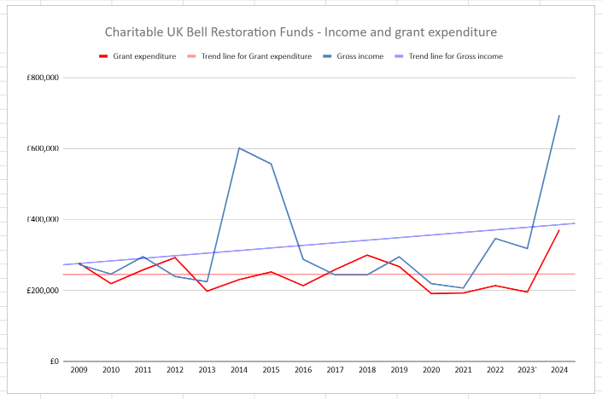
But ringers do this. According to figures published by the Charity Commission, over the last 15 years they continue to raise money for stand-alone BRF's faster than they are spending it. The amount raised by these BRF's has grown steadily from about £300k to about £400k per annum, thanks in certain years to large bequests, whilst the amount of grants paid out has remained relatively static at around £250k per annum, despite inflation.
So much money is now held in reserve that at current spending levels around 20 years of grants could be funded, without more income. In 1996 this was 5.3 years. Put another way £1 donated today will probably not be spent for 20 years, and rather than being invested for longer term capital growth, much of this is invested in short term deposit accounts.
Anything that gets members more involved and debating important issues such as this is welcome. Our ringing societies need to move forward and adapt, not remain firmly rooted in the past, just because that is what we do.
-
Peter Sotheran
156Quite so! Earlier this year, the124 yr old clock at the top of our tower stopped and our usual ministrations failed to restart it. The clock engineers quoted £1800 to repair/replace worn out parts. Comments on the local Facebook page showed that local residents were missing the town centre timepiece. I explained the nature of the problem and opened a JustGiving/GoFundMe page. Public sentiment was very much on our side and within 3 weeks we had raised the £1800 to cover the repairs.
-
Robert Brown
27"Given that CCCBR reps are appointed by the guilds and associations, I wonder why people choose to continue to send reps if they do not believe that they are doing a good job".
The reality is that tradition just carries on and with limited engagement by members and a lack of challenge then the statuss quo remains . The Guild of Devonshore Rigners held events to discuss up coming CCCBR meeting i think it was about 14 people who attended take out the Reps and Guild officer you are left with perhaps half a dozen , some one who went can correct my figures 6 would amount to about 1% of the guild membership , so hardly a ringing endorsement.
suspect that most ringers are entirely unaware of the technical mechanism by which their Apps, Ringing Room or Bell Board magically have a list of every known method. But as Graham lists as his first item, that is a service that works like clockwork provided by the CCCBR. And ringers do value that, even if they don't know where it comes from or who provides it.
I for one are very grateful for the work aound recording methods and composition and other technical work , but the majority of ringers I ring with outside of peal ringing , which amounts to a significnat number have no interest in the more technical aspects -
 John de Overa
627Has the CCCBR looked at the retention of ringers from that imitative and lessons learned. A similar question that could be thrown at ART — Robert Brown
John de Overa
627Has the CCCBR looked at the retention of ringers from that imitative and lessons learned. A similar question that could be thrown at ART — Robert Brown
The last time I could find the data, which was some time ago, the drop-out rate between ART L1 & L5 was 95%
Some caveats however: just because people stop progressing through ART it doesn’t mean they have stopped ringing. I myself am in that category, I never got past L4. And although we follow the ART teaching scheme, we haven't registered any of our newer learners, many adults aren't interested and/or find the logbook / certificate thing a bit infantilising. -
John de Overa
627The research I reported in The Ringing World a while ago suggests that big recruitment drives do not have a lasting effect. If you didn't see it there's a copy at: https://jaharrison.me.uk/New/Articles/RecruitmentDrives.pdf — John Harrison
An interesting article, I think the assessment at the end is pretty much spot on. I know of one tower that took on around 15 people for RftK, within a year, only 1 was still ringing. My tower has taken a different approach, we've decided we'll only take 2 new starters at the same time - we've even asked people to wait. Our thoughts are that learning to ring is a big investment in time from everyone involved, and resources are scarce, both in terms of learners and teachers. We try to maximise the chances of success by giving people sufficient rope time, and also by integrating them into the band as quickly as we can. Both of those are easier with a smaller but steady stream of joiners. It's not been a quick process but we've grown the band from 4 to 11, and we have another potential starter in a few weeks. -
John de Overa
627Three-day courses teaching around 60 students at a time are not going to make a significant impact on delivering 10,000 new ringers over the next few years. Regular weekly sessions at a local level like those at St Clements are far easier to organise, less expensive to attend, and could engage a lot of new people — Roger Booth
Every year I look at the course prospectuses and every year I decide I'm not going to bother. The main reason is that as an adult starter I know the key to success is regular practice. Without that, a 3 day course isn't going to help much. But ongoing support takes long-term commitment from the organisers and the helpers, I'm not convinced that's easier to deliver than 3 day courses.
One of the things I've heard from people who help or teach at courses is that they get the same people coming back each year, often having made little progress. I think that's almost certainly because the courses aren't backed up by regular local opportunities. Personally I'd love to progress to 8 method ringing, but the activities in my area are pretty much closed shops, so I've given it up as an aspiration. I don't think that's uncommon.
Efforts like RftK & R2030 don't directly deliver a single new person and a teacher to the end of a rope in a tower, that's done locally. I'm not saying those initiatives shouldn't happen but without grass-roots support behind them, they are mostly futile. The challenge for the CCCBR is it's a top down organisation, whereas ringing is inherently a grass-roots activity. -
John Harrison
585we generally only take on a couple at a time for that reason. However in the late 70s / early 80s we used to take on five or six a year and keep most of them, and grew to over 30 ringers for a few years. Not sure ho we did it, especially as one person taught each batch.
-
Roger Booth
135We seem to have covered a lot of ground and are in danger of veering off topic. However, aren’t these all symptoms of our Victorian structures, and an ageing ringing population.
Ringers identify with a tower, which is part of a District/Branch, which is part of a Guild/Association, which sends representatives to the Central Council, which is remote and under-funded. It can set up initiatives, but it cannot ensure that they are delivered at a local level.
Human motivation is such that being a tower captain, officer or representative in this labyrinthine structure confers prestige and power (Maslow), so there is resistance to change the structure. There is also evidence that people are able to cling on to power long after their ‘sell by’ date, putting others off, and leading to a slow overall decline.
CRAG recommended replacing the Council with a new national body for all ringers, but this has not been pursued. However, new ringers are willing to pay hundreds of pounds to attend residential ringing courses, and there are vast resources lying unused and poorly invested in BRF’s, which could instead be used to arrest the decline at a local level. -
John de Overa
627here are vast resources lying unused and poorly invested in BRF’s, which could instead be used to arrest the decline at a local level. — Roger Booth
I've seen this suggested multiple times and whilst I agree it's sensible, aren't most BRFs registered charities, so getting approval for a change of the charity’s purpose from the Charities Commission would be needed? I'm not saying that can't be done, but it's not as simple as the trustees just deciding to start spending the money on training. -
John Harrison
585yes most of them are charities, so would need Charity Commission approval to change their objectives. But the charity commission’s concerns are not to prevent change, they are to ensure that the objectives meet charitable criteria and that the charity is effectively using them. Funds sitting unused are not being effective and supporting ringing might be more effective than adding too an already under used stock of bells.
-
Roger Booth
135so getting approval for a change of the charity’s purpose from the Charities Commission would be needed? — John de Overa
It’s far simpler than you might think, the main problem will be those officers who have been in post a long time and who are resistant to change.
To start with most Guilds and Associations put a proportion of their annual subscriptions straight into their BRF, where it becomes a ‘restricted fund’. If it’s not going to be spent for a decade or two, why not reduce that proportion, or even pause doing it, and put that money into a separate training and development fund, to be spent on things such as putting on promotional events, paying teachers expenses and providing training equipment and materials. If properly engaged, members will be very supportive. When consulted in 2022, members of the Essex Association came up with some very useful suggestions - see https://eacr.org.uk/wp-content/uploads/2024/07/survey-feedback.pdf
Societies could even increase their subs to help. That does not require any approval from the charity commission either. Also, many BRF trustees have not reviewed their charitable objects for decades. However, charity commission guidance is that they should review them regularly and make sure that they remain relevant. Guidance is also that they should spend money on delivering charitable activities and not accumulate large reserves. If they are holding large amounts of cash on deposit for a long period, they should also take professional investment advice (how may people would leave their pension pot in a deposit account?).
Many BRF’s have very narrow objects, so a review would be welcomed by the Charity Commission. For example, nowadays it would be prudent to consider installing a dumb bell and/or simulator, even as a stand-alone project and for this to qualify for a grant. There are also many unattractive and unwelcoming ringing rooms. Grants towards painting, improving the heating and lighting and replacing worn carpets etc. ought to be eligible.
Also, how about periodic inspections and maintenance visits by a bell-hanger, perhaps using it as an opportunity to train-up local steeple-keepers at the same time. This would be useful, especially if several towers in the same local area could be visited in the same day.
There’s a lot that could be done. The Central Council ought to be encouraging Guilds and Associations to follow best practice, like it used to do with its regular triennial surveys up to 1996. -
Graham John
369These forums can have a like button :up: (by default in fact), but it was turned off for the reason John gives. However, I disagree with that view. A like button is an easy way of saying that you agree with someone's comment without having to post just to say that. I don't think anyone who uses likes on other platforms is using it to like the person rather than the comment.


Welcome to your Ringing Forums!
If you would like to join in the conversation, please register for an account.
You will only be able to post and/or comment once you have confirmed your email address and been approved by an Admin.
Categories
- BELL INSTALLATION & RESTORATION PROJECTS
- CALL CHANGES
- CCCBR Consultation
- EDUCATION AND TRAINING
- GENERAL
- MEMBERSHIP SOFTWARE
- MEMBERMOJO
- METHOD RINGING
- METHODS
- COMPOSITION
- CONDUCTING
- HANDBELL RINGING
- PUBLIC RELATIONS
- RECRUITMENT & RETENTION
- Ringing 2030
- RINGING SIMULATORS AND SOFTWARE
- RUNNING A TOWER
- TOWER MAINTENANCE
- YOUNG RINGERS
- DEVELOPMENT PATHWAYS
- SCHOOLS
- UNDER 18s RINGING
- UNIFORMED GROUPS
- UNIVERSITY RINGING
- YOUNG RINGERS HUB WEBSITE
- YOUTH LEADERS
More Discussions
- Contact Us
- RingingForums Policy
- Terms of Service
- Useful Hints and Tips
- Sign In
- © 2026 Ringing Forums